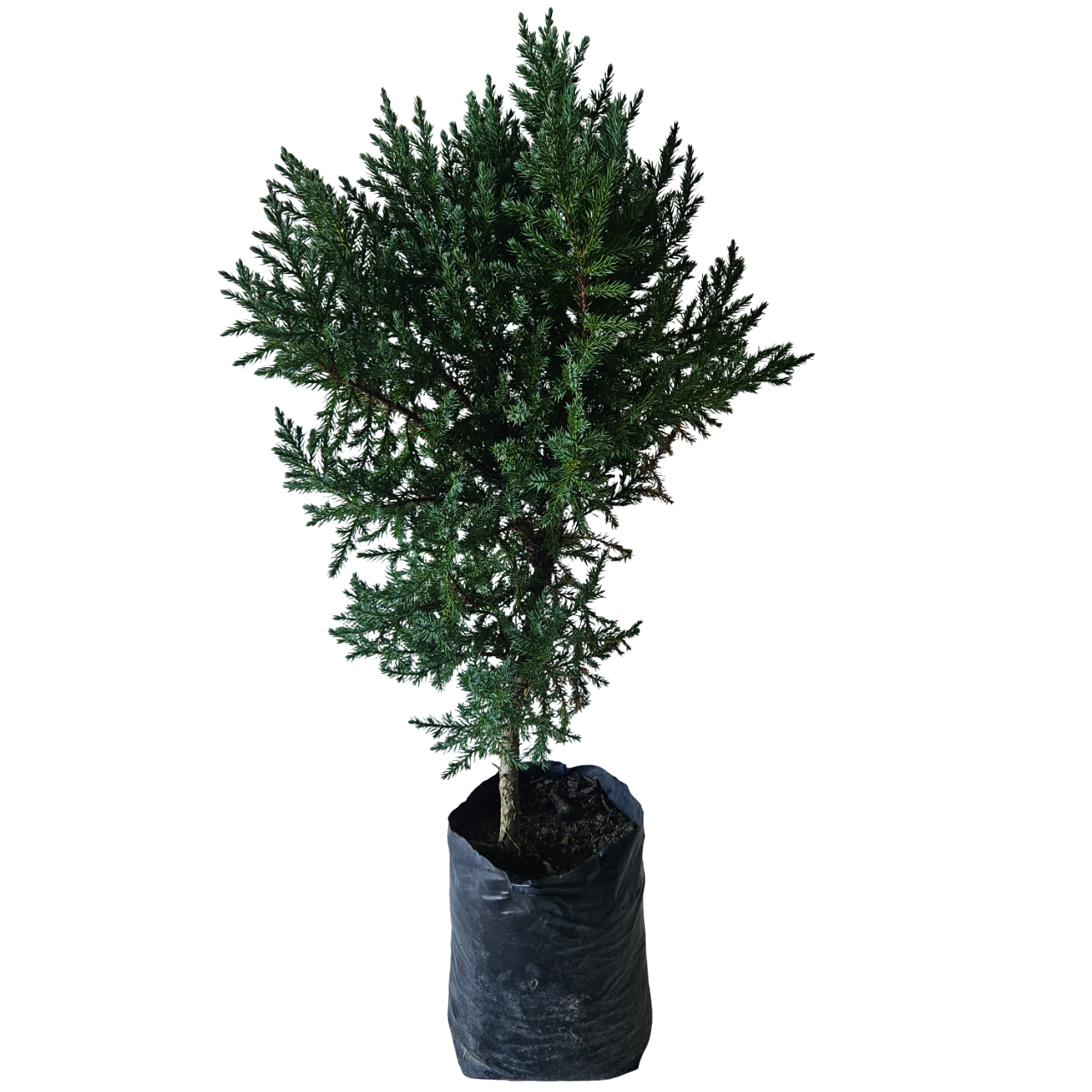
Close your eyes and crush a handful of its foliage—that bright, lemony scent is one of this tree’s most delightful surprises. The Monterey Cypress, also known as Macrocarpa, is a fast-growing evergreen that has become a familiar sight across lowland areas of the Western Cape. Its dense masses of small, scale-like leaves form a uniform, lustrous dark green, packed into upright, bushy branchlets. Young trees grow in a neat pyramidal shape, while mature specimens develop a broad, spreading crown. Small, brown seed cones persist on the branches for years, adding subtle texture.
This tree hails from the Monterey Peninsula on the coast of California, and it has adapted beautifully to our temperate climate. It demands full sun—at least 6 hours of direct light—to keep its growth dense and its colour rich. Well-drained soil is essential; sandy or loamy types suit it best. Once established, it’s remarkably drought-tolerant. Where it truly excels is in coastal gardens, standing up to strong winds and salt spray with ease. A word of caution: it’s susceptible to Cypress canker in inland areas with hot summers, so it’s best reserved for mild coastal conditions or places with cool summers. Growing 3–5 metres in 10 years (and up to 10 metres or more at maturity), it’s a hard-working tree for windbreaks, privacy screens, formal hedges, or as a striking solitary specimen.
Key Features:
- Dense, scale-like leaves in uniform, lustrous dark green for lush year-round presence
- Bright, lemony fragrance when foliage is brushed or crushed
- Fast-growing with a neat, pyramidal shape when young for rapid screening
- Exceptionally tolerant of coastal winds and salt spray
Gardening Note: Plant in full sun in well-drained soil. Water regularly until established; mature trees are drought-tolerant but appreciate occasional deep watering during dry spells. Prune lightly to maintain shape or hedge height, best trimmed in spring and late summer. Susceptible to Cypress canker in inland areas with hot summers; best suited to mild coastal gardens. Can become very large at maturity (up to 10m+), so give it plenty of space away from buildings and boundaries.