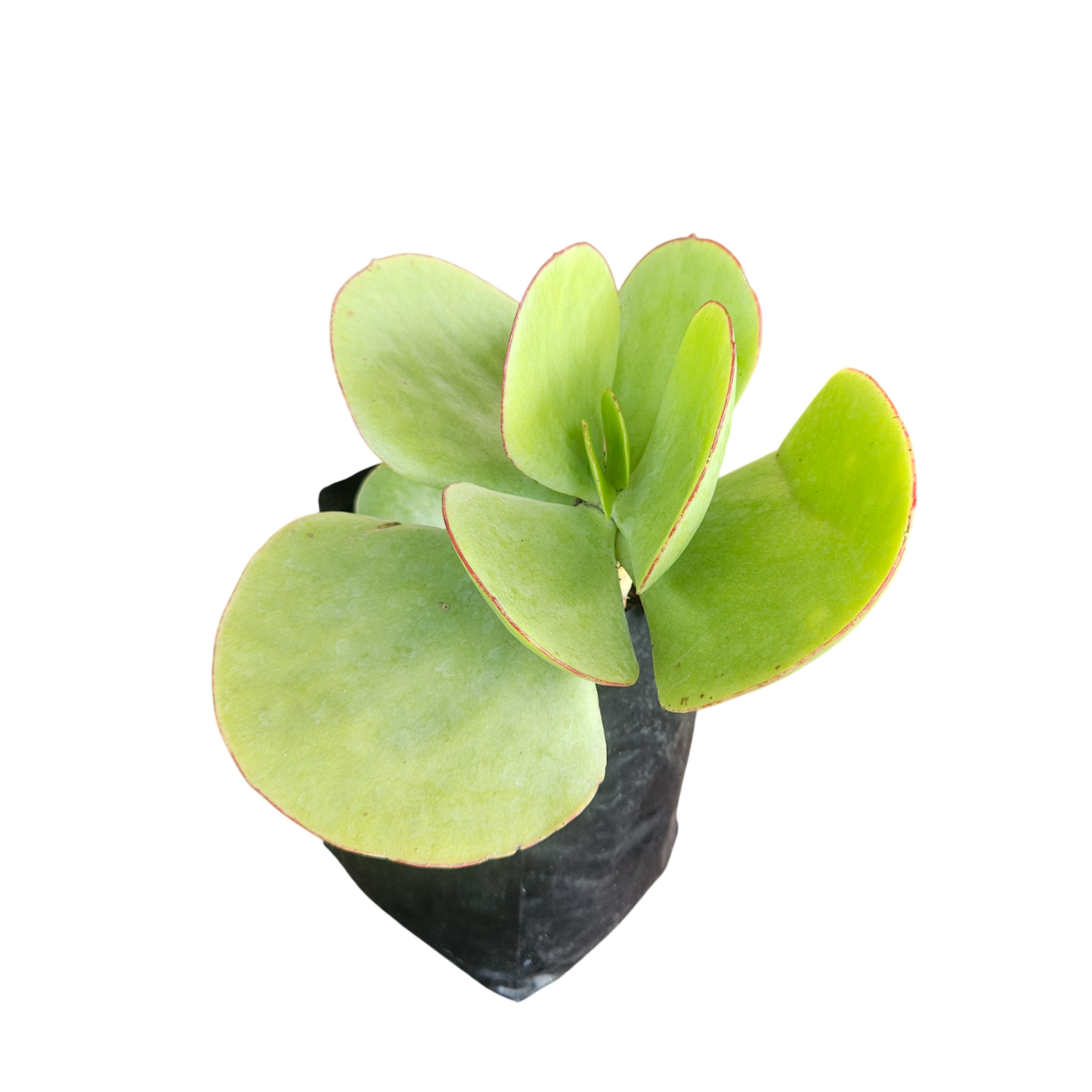
Look closely at this succulent, and you’ll see why it’s called Paddle Plant. Also known as Flapjacks or Desert Cabbage, this unique, rosette-forming succulent features large, rounded, fleshy, stalkless leaves that can grow up to 15 cm long and 9 cm wide. Those distinctive leaves are a soft, powdery grey-green to silvery-white, covered in a delicate, waxy bloom. In full sun—especially during cooler winter months—the leaf margins blush with stunning shades of deep red to burgundy, creating a breathtaking, ever-changing display. After several years, usually from autumn to spring, it sends up a tall, single flower spike reaching over 1 metre, bearing dense clusters of sweetly fragrant, golden-yellow, urn-shaped flowers. After this spectacular event, the main plant dies, but not before producing numerous small offsets at its base.
Proudly native to South Africa (from the Cape Province through to Lesotho and Eswatini), Paddle Plant is perfectly at home in local gardens. It thrives in full sun to partial shade—bright light brings out the most intense red leaf margins. It demands very well-drained, sandy or gritty soil, and once established, is remarkably drought-tolerant. It handles coastal conditions well but is sensitive to severe frost. Reaching 30–60cm tall when in leaf (up to 1.5m in flower) with a spread of 30–60cm, it’s perfect for rockeries, succulent gardens, or as a striking living sculpture in a large container.
Key Features:
- Large, rounded, fleshy leaves with powdery grey-green colour dramatically edged with red to burgundy in full sun
- Tall flower spike with fragrant, golden-yellow blooms after several years
- A proud South African native, perfectly adapted to water-wise gardens
- Fascinating monocarpic life cycle—dies after flowering, leaving “pups” behind
Gardening Note: Plant in full sun in very well-drained, sandy or gritty soil. Avoid heavy, waterlogged soils, especially in winter. Water regularly until established, then allow soil to dry completely between waterings. Reduce watering significantly in winter. For the most intense red leaf margins, provide full sun, especially during cooler months. Sensitive to severe frost; in colder inland areas, grow in a movable container. Protect from snails, which can permanently disfigure the leaves.