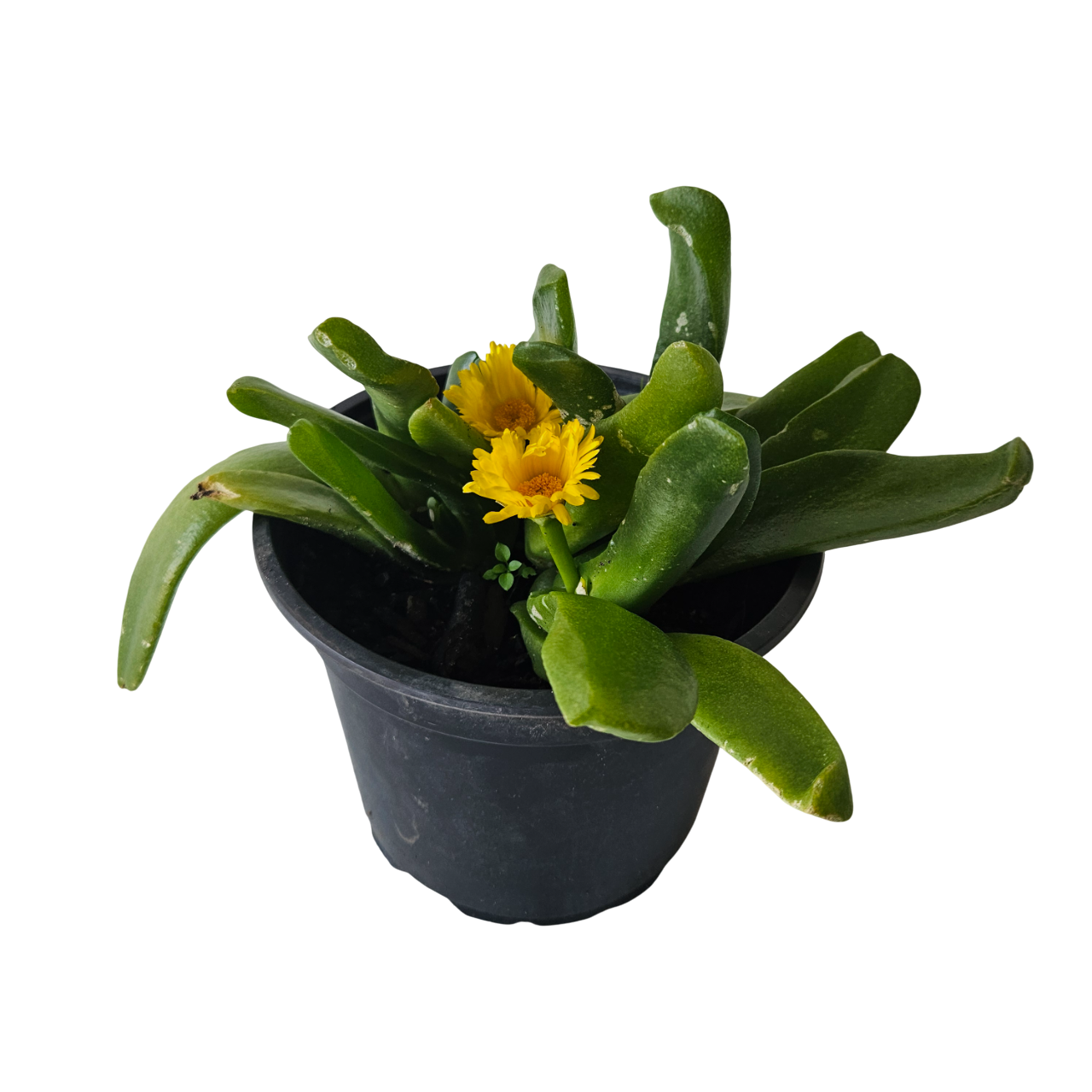

Those fleshy, tongue-shaped leaves are unlike anything else in the succulent world. The Tongue Plant, also known as Tongblaarvygie, is a low-growing, clump-forming succulent with a nearly stemless, spreading rosette of soft, smooth, grey-green to bright green leaves arranged in two opposite vertical rows. Those distinctive leaves may flush with attractive bronze to purple tones when the plant goes dormant in summer. In winter and spring, large, dazzling, daisy-like flowers appear in brilliant, sunny yellow, reaching up to 7 cm in diameter and often carrying a delicate, sweet fragrance.
Proudly endemic to the Western Cape (occurring naturally in the arid Little Karoo near Oudtshoorn), the Tongue Plant is perfectly at home in local gardens. It thrives in full sun to bright, indirect light—at least 4–6 hours of direct sunlight to flower well, though some protection from harsh afternoon sun helps. It demands very well-drained, sandy or gritty soil, mimicking its natural habitat of loamy sands with quartzite. Once established, it’s remarkably drought-tolerant, needing little water, especially during summer dormancy. It can withstand temperatures as low as -12°C, making it exceptionally cold-hardy. Reaching only 5–6.5 cm in height and spreading up to 30 cm wide, it’s perfect for rockeries, succulent gardens, containers, or as a charming accent in a sunny, well-drained spot.
Key Features:
- Soft, fleshy, tongue-like leaves that may turn bronze or purple in summer
- Large, brilliant yellow, daisy-like flowers in winter and spring provide cheerful colour when most plants are dormant
- A true Western Cape treasure—found naturally only in the Little Karoo near Oudtshoorn
- Exceptionally drought-tolerant and cold-hardy (to -12°C) once established
Gardening Note: Plant in full sun to partial shade in very well-drained, sandy or gritty soil. Water regularly until established, then allow soil to dry completely between waterings. During summer dormancy, reduce watering significantly—only when leaves begin to wrinkle. Ensure plenty of bright light, especially during the winter growing season. Easily propagated by stem cuttings taken at the end of summer or by seeds sown in spring.