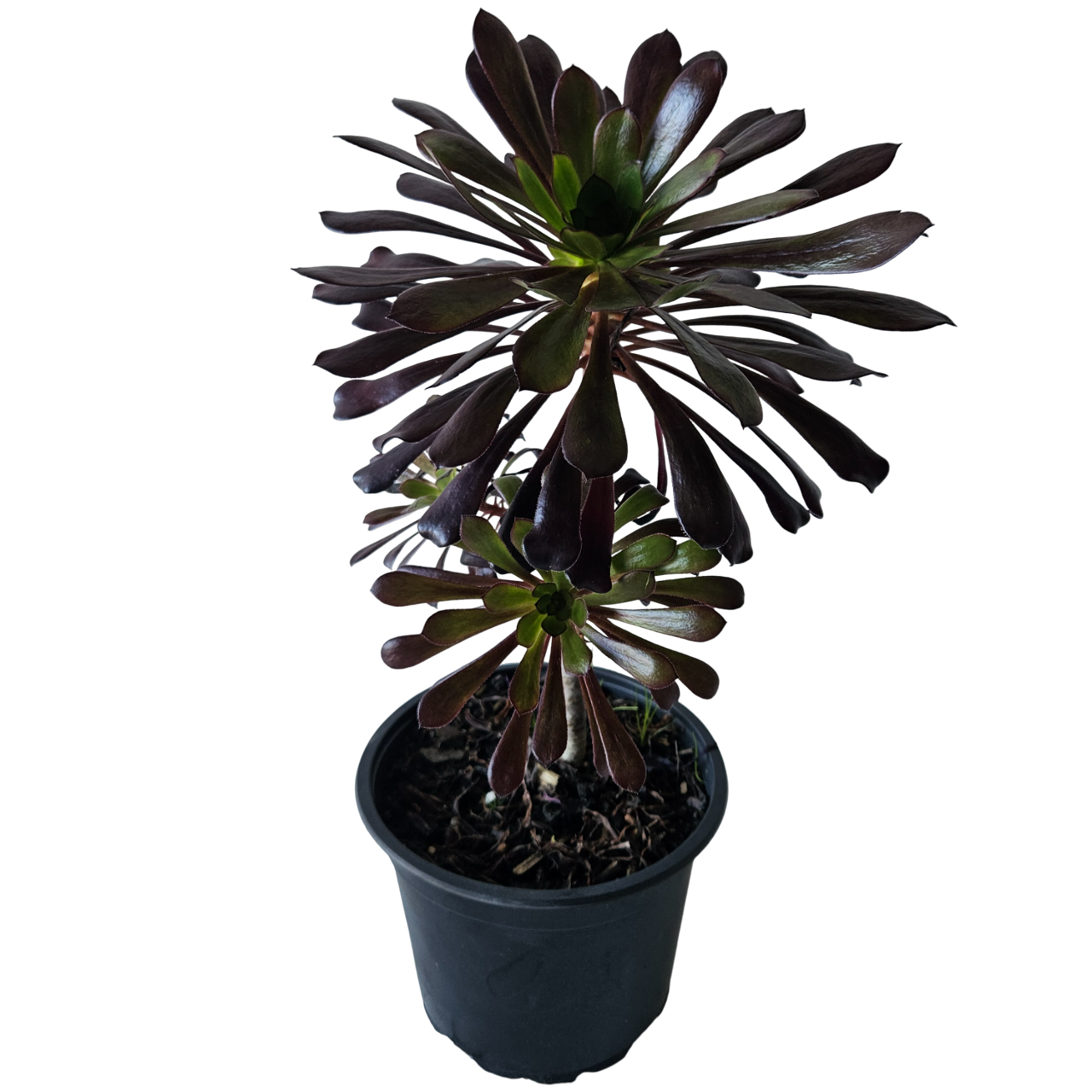
When the sun hits those deep burgundy rosettes, they appear almost black—a dramatic, moody accent that stops you in your tracks. Black Tree Aeonium, also known as Black Rose or Zwartkop, is a striking, evergreen succulent shrub treasured for its lustrous, near-black foliage and its bold, architectural form. It features glossy, fleshy leaves arranged in large, perfect rosettes at the ends of thick, bare, upward-curving stems, creating an almost tree-like silhouette. Those extraordinary leaves are a deep, rich burgundy that appears black in full sun, providing the most dramatic accent in any planting. In late winter to early spring, mature plants send up tall, conical clusters of small, starry, bright yellow flowers that contrast vividly with the dark foliage.
Native to the Canary Islands, this Mediterranean succulent is perfectly adapted to the Western Cape’s winter-rainfall climate. It thrives in full sun to partial shade, needing at least a few hours of direct sun to develop its deepest, blackest colouration. It demands well-drained, gritty soil and, once established, is highly drought-tolerant. As a winter grower, it appreciates the cool, wet winters and goes somewhat dormant in summer, handling coastal conditions well but is sensitive to severe frost. Reaching up to 1–1.5m tall and wide, it’s perfect for containers, succulent gardens, or as a striking focal point.
Key Features:
- Large, glossy rosettes of intense, near-black purple foliage for year-round architectural interest
- Towers of bright yellow, star-shaped flowers in late winter create a stunning contrast
- Water-wise once established; perfectly adapted to local conditions
- Ideal for containers, rockeries, or modern landscapes
Gardening Note: Plant in well-drained soil in full sun for the most intense colour. Water regularly until established; mature plants are highly drought-tolerant. Allow soil to dry out completely between waterings, especially in winter. Protect from severe frost. After flowering, the flowering rosette will die back—simply prune the stem to encourage new branching growth.