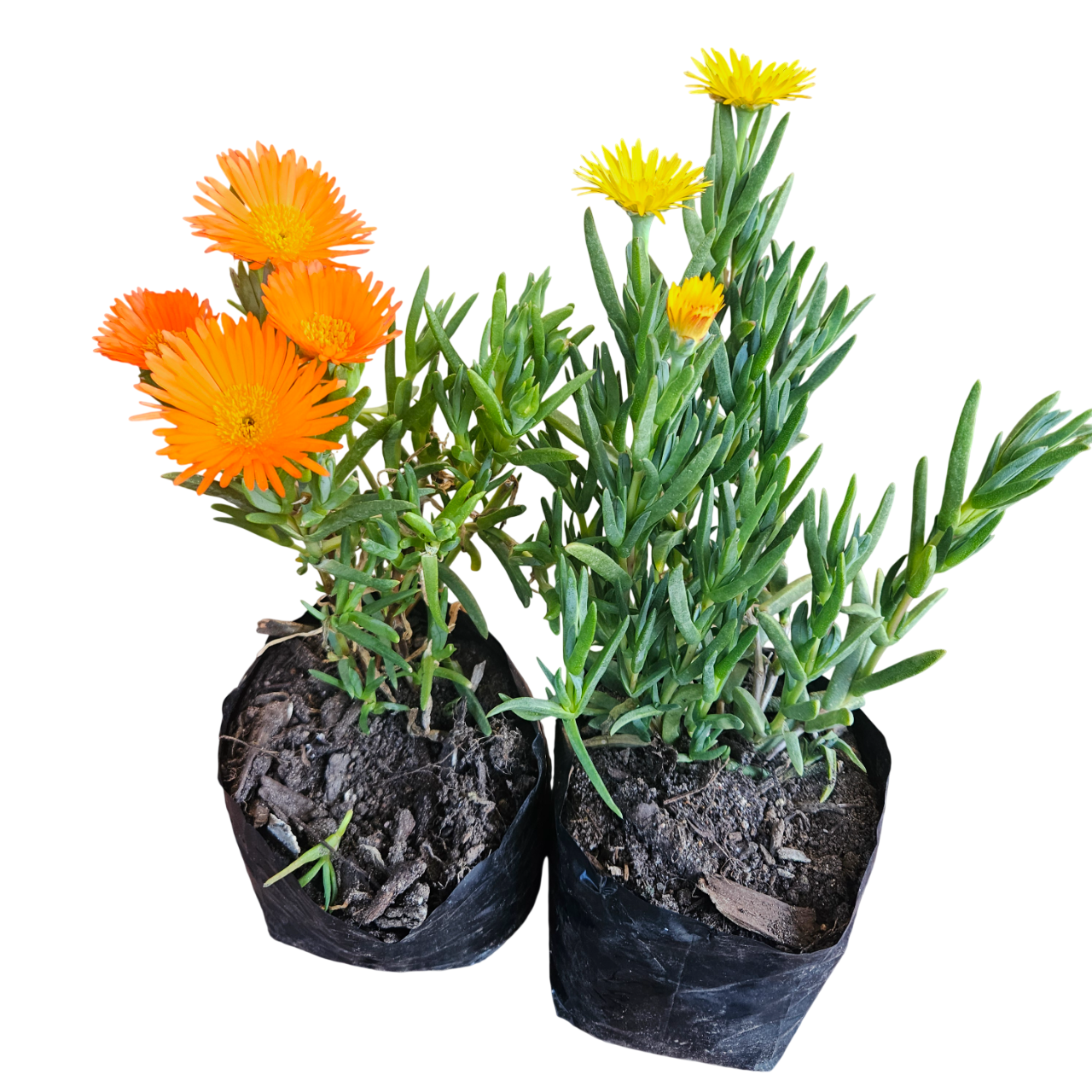
Wait until midday, when the sun is high, and watch these brilliant coppery-orange blooms burst open as if responding to a signal. Copper Vygie, also known as Vingerkanna, is a fast-growing, evergreen succulent groundcover that forms a dense, spreading mat of pale green to blue-green, triangular, fleshy leaves—soft and brittle to the touch. From spring onwards, and intermittently throughout the year, it produces an abundance of dazzling, daisy-like flowers in striking coppery-orange to dark orange, each with a sunny yellow centre and often a purplish underside. Those jewel-toned blooms open in the bright heat of the day, attracting butterflies, bees, and other pollinators, then close as the light fades.
Proudly native to South Africa (occurring naturally in the arid Karoo regions of the Western and Northern Cape), Copper Vygie is perfectly at home in local gardens. It thrives in full sun—at least 6 hours of direct light for the most abundant flowers and compact, healthy form. It demands very well-drained, sandy or gritty soil and, once established, is exceptionally drought-tolerant, needing very little water. It excels in coastal conditions, handling salty air and windy positions with ease, and tolerates light frost (to about -5°C) if soil is kept dry. Reaching 20–30 cm tall and spreading up to 1 metre or more, it’s perfect for rockeries, mass plantings as groundcover, stabilising banks, or cascading from containers.
Key Features:
- Masses of luminous, daisy-like flowers in striking coppery-orange with yellow centres from spring through summer
- Fascinating “midday” opening habit—flowers open in bright heat and close as light fades
- A proud Karoo native, perfectly adapted to arid, coastal, and water-wise gardens
- Nectar-rich blooms attract butterflies and bees; drought-tolerant once established
Gardening Note: Plant in full sun in very well-drained, sandy or gritty soil. Avoid heavy, waterlogged soils, which cause root rot. Water regularly until established; mature plants are highly drought-tolerant. Do not use compost or fertiliser—both encourage leaf growth at the expense of flowers. For best effect, replace plants after the second year. Easily propagated from stem cuttings.